Look calm. Keep going. Don’t be the person who cannot handle pressure.
“Composure under pressure” is seen as synonymous with “effectively handling pressure” in most cultures. We learn this in school, in families and in professional settings.
As a result we try to resolve stress by thinking harder, carrying more and presenting a composed outside, even when our body and emotions are clearly trying to get our attention.
Overriding stress is a short-term survival option. In modern professional life, we can keep it up for a while, but not without cost.
For a long time, my own response to pressure was to run harder. More responsibility meant more effort. More complexity meant more thinking. More tension meant pushing through more fanatically.
Over sixteen years ago, it became impossible to keep pretending the stress I experienced was just the inevitable side effect of a demanding professional life. I realised that to thrive in the long run, I needed to change the way I reacted to pressure.
Before that time, I mostly thought of stress as something caused by circumstances. High workload. Too little time. Deadlines. Difficult dynamics.
All of that can be true.
But it is not the full picture.
While learning to lead differently, I began to understand how subconscious perception determines the nature of our stress reflex.
In turn, our stress reflexes directly influence how we perceive reality, make decisions, relate to others, and how we interpret risk, responsibility and control.
“Following your gut” does not mean impulsively acting on the fight, flight or freeze response. It means using sensory information to make better-informed decisions and act consciously.
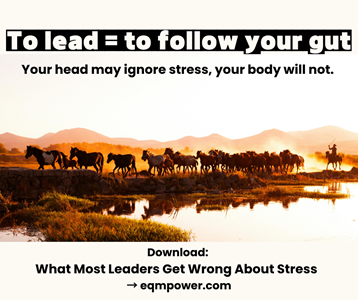
To lead well, you have to learn to read the intelligence of your body before your head explains it away.
Because while your head is able to ignore stress, your body will not.
The body registers pressure, ambiguity and relational tension long before the rational mind does. Leaders who ignore those signals do not become stronger, but less informed.
Horses make the fine line between congruence and inner tension visible with remarkable clarity.
A horse cannot suppress tension the way humans are able do. It uses sensory clues to choose action instantly, and can release tension as quickly as it builds it. Not by ignoring it, but by moving through it.
Stress is not separate from leadership. It is inevitable that leadership will include stress. The key to functioning well is learning to read and regulate our stress clues, instead of remaining stuck in coping patterns that reduce overview and creativity.
This is the foundation of Leadership Under Pressure — an experiential training that includes what natural horse behaviour shows us about stress-savvy leadership.
The training helps leaders engage with stress as a strategic issue, long before it becomes a health problem.
By Joss Janssens, Founder EQMPower Leadership Development
Comments