On the surface, stress reactions often do not look like stress at all.
They look like decisiveness.
Like diligence.
Like a strong awareness of responsibility.
Like loyalty.
Like speed.
That makes them difficult to recognise, both in ourselves and in others, because the difference is subtle.
Under pressure, decisiveness can shift into haste.
Diligence can become control.
Responsibility can turn into doing everything yourself.
Loyalty can mean continuing beyond your own limits for too long.
And calmness can become a posture that conceals tension.
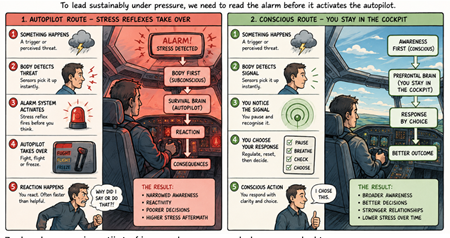
From the outside, the behaviour still looks professional. But the control system has changed: the autopilot of our survival reflexes is at the controls instead of conscious awareness.
If this only lasts briefly, it is not necessarily a problem. But when it continues, it gradually erodes the quality of collaboration and decision-making, until crises and health problems begin to emerge.
In assessing our performance we usually focus on “What is happening and how is it going?”
But a key question is: Which system is driving our behaviour?
• A quick decision may come from clear overview.
But it may also come from anxiety and urgency.
• Additional control may be necessary.
But it may also be an attempt to soothe inner uncertainty.
• Taking over someone else’s work may look like leadership.
But it may also mean that, under pressure, someone no longer trusts the process or their team
From the outside, the behaviour may look almost identical.
The difference lies in what happens before it. Is there still enough space to observe, assess and choose consciously? Or has the stress reflex already taken over the controls while the conscious brain is sidelined?
Stress-free work does not exist. The challenge is to acknowledge stress and remain consciously at the controls.
That is why effective stress and burnout prevention should not be treated as the responsibility of HR alone. It is a function of good leadership. It means learning to recognise, as early as possible, the point at which a strength begins to tip into its stress-driven version — both in ourselves and in the teams around us.
Which leadership quality do you often notice shifting into its stress-driven version when pressure rises?
By Josselien Janssens, Trainer-coach, Founder EQMPower Leadership Development
Comments